
TikTok Hooks: Writing the First Line of Your First Video (Formulas and 20 Examples)
For you if you would like to post a first TikTok video, do not know where to start, and feel a little uneasy about the people close to you watching.
By Creatype · Updated November 7, 2026 · 10 min
In short
If you have not posted anything yet, start with the smallest step: a single sentence. A TikTok hook is the first sentence, or the first image, of your video. To write one, say who the video is for, announce what it delivers, then keep that promise in the rest of the video. For a first time, a simple sentence that sounds like you is plenty.
How do you write the hook of your first TikTok video?
You do not need a perfect video, and you do not need to talk about yourself. This guide presents six formulas, twenty examples sorted by intent, a way to choose the mood of your account before you film, and the mistakes to avoid. The examples are invented: they are templates to adapt to your own world.
- The six hook formulas
- Choosing your first hook in four steps
- 20 examples sorted by intent
- Saying, writing or showing the hook, even without appearing on screen
- How to tell whether a hook works, once you have published a few videos
- Common mistakes
Which hook formulas can you use on TikTok?
Almost every hook rests on one of these six formulas. Pick one before you write: it spares you a blank page. If you hesitate, take the one that feels most natural to say out loud.
- The question: “Why…?”, “Did you know…?”. It opens a gap that the video fills.
- The result first: you show or announce the ending, then explain how to get there.
- The problem: you name a difficulty your audience knows well.
- The unexpected statement: you say the opposite of what people believe. It must be true and demonstrated in the video.
- The scene: you start in the middle of a situation (“This morning I almost cancelled everything…”).
- The direct address: you name your audience (“If you like taking notes…”, “If you are just starting…”).
How do you choose your first hook in four steps?
Before you write, think of your world as a moodboard: two or three colours, a setting, a tone of voice. The hook should sound like that whole picture. For a first video, pick a topic about a thing (a notebook, a routine, a tip) rather than about you: you will feel more at ease, and the people close to you will see a subject, not a confession.
In the article where TikTok collects tips from creators, one of them recommends opening with a teaser or a strong highlight from the video, and avoiding a rambling start. The method below applies that advice.
Example: the topic of the video is “a simple morning routine”. With the problem formula, the hook becomes “Your morning routine is too complicated.” With the question: “How do you know if your morning routine is too packed?” With the scene: “This morning I gave up on my routine after ten minutes, and I understood why.” The third is longer but more concrete. Choose the one you feel like saying.
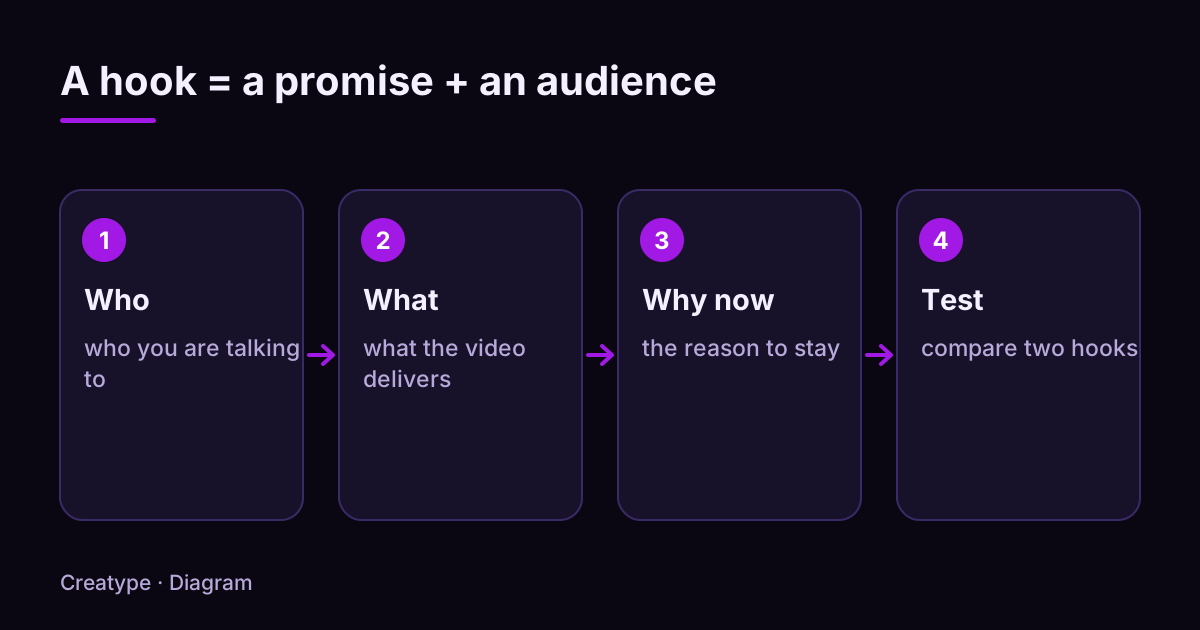
- Step 1: write in one sentence what the video delivers. Example: “This video shows how to lighten a morning routine.”
- Step 2: find the most concrete word or detail in that sentence. Example: “morning routine”.
- Step 3: pick one of the six formulas and write three versions. Example: “Your morning routine is too complicated. Here is how to lighten it.”
- Step 4: keep the shortest version that is still accurate, read it aloud, alone, and check that it fits in one breath.
TikTok hook examples to intrigue, tell a story and surprise
The ten examples below are invented to illustrate each intent. Replace the items in brackets with your own topic, and keep only what sounds right in your own mouth.
- Curiosity – Example: “There is one gesture in my evening routine that I have never shown, and it is my favourite.”
- Curiosity – Example: “Here is what my notebook holds on the days I have no inspiration.”
- Curiosity – Example: “Here is what I always carry in my bag to take five minutes for myself.”
- Curiosity – Example: “Someone asked me a question about (your topic) that I had never asked myself.”
- Story – Example: “I deleted my first video three times before I posted it.”
- Story – Example: “I tried a morning routine for seven days. Here is what held.”
- Story – Example: “I made the same mistake three times before I understood.”
- Surprise – Example: “Stop asking yourself whether you are motivated enough. Ask yourself this instead.”
- Surprise – Example: “The advice you read everywhere about (your topic) does not suit me. Here is what I do.”
- Surprise – Example: “It is not a lack of willpower. It is a list that is too long.”
Rather not do it by hand? Paste a TikTok link and get the audience profiles.
Analyse for freeTikTok hook examples to help, prove and invite
These ten other examples, also invented, aim at helping, proving and starting a conversation. They suit a tutorial, a review or a demonstration.
When you adapt an example, keep only the mechanism. A sentence copied word for word stays vague for your audience: replace it with a detail nobody else can give, such as the colour of your notebook, an object on your desk, a habit of your own.
- Help – Example: “Here is how to write three lines in your notebook when you have no time.”
- Help – Example: “Three questions to ask yourself on Sunday evening to prepare your week.”
- Help – Example: “If you are starting a journal, begin with this page, not the one people recommend.”
- Help – Example: “A gentle way to turn down an invitation.”
- Proof – Example: “Here is my notebook before, then after a week of use.”
- Proof – Example: “I am showing you my list for today as it is, including what I did not do.”
- Proof – Example: “Here is my first draft, then the version I am posting. Look at the first sentence.”
- Invitation – Example: “Tell me in the comments: which small habit are you proudest of?”
- Invitation – Example: “Do you prefer the morning version or the evening one? I am comparing both.”
- Invitation – Example: “Tell me which topic you want in the next video.”
Should you say, write or show the hook?
A hook exists in three places: what you say, what you write on screen, and what we see. The simplest approach is to make all three say the same thing. If your voice announces one topic and the screen shows another, the viewer has to choose, and may leave.
If you are not comfortable facing the camera for a first time, you can leave the hook to text and image: a sentence on screen, an object from your world (notebook, mug, colour palette) visible from the very first frame, and your voice taking over afterwards, or not at all.
Among the tips from creators published by TikTok, one recommends opening with a teaser or a strong highlight from the video, which amounts to showing the hook before saying it. Another creator calls captions essential, which makes a written hook all the more useful.
- Spoken: suited to videos where you talk to the camera or use a voice-over. Keep it under about twelve words.
- Written: useful when the sound is off or when the voice comes after an image. A few words are enough.
- Shown: the result, the object or the action visible from the very first frame.
- Check the three versions side by side before filming: read the sentence, look at the first frame with the text on it, and ask a friend what they think the video is about.
How do you test two TikTok hooks, later on?
This step is not for right now. Publish your first video first: that is the one that counts. Once you have a few videos, you can compare two hooks for the same idea. The results of a single video depend on many factors: topic, timing, the mood of the audience. One comparison proves nothing, and no single video tells you whether this is right for you. Repeat the test before you draw conclusions.
To measure, TikTok’s analytics tutorial describes per-video data: total views, average watch time and how long viewers watched the video. It also advises looking at trends over time rather than video by video, and not treating any single metric as the most important.
- Choose a video idea and write two hooks, A and B, that promise the same thing with two different formulas.
- Film two videos where only the start changes: same topic, same body, same ending, same length.
- Publish them at comparable moments, for example two days of the week at the same time.
- For each video, note the hook used, the formula, the views and the average watch time.
- Repeat with two or three other topics, keeping the same principle: A against B.
- Then compare formulas, not isolated videos: which one gives a higher average watch time across the set?
- Keep the formula that comes out ahead most often, then test it against a new formula.
What are the most common mistakes with TikTok hooks?
- Waiting for the perfect video before posting the first one: a simple sentence and a short video beat a project that stays in drafts.
- Promising something the video does not deliver: viewers notice within seconds.
- Starting with “Hi everyone” or an introduction before the promise.
- Writing a hook too long to say in one breath.
- Using a technical word your audience does not know.
- Copying a hook seen elsewhere word for word, without adapting it to your topic or your world.
- Changing the hook on every video without noting what you tried.
- Judging a formula on a single video.
- A hook that is spoken, written and shown as three different things.
- Never reading the hook aloud: a sentence that reads well can sound wrong.
- Forgetting to check, sentence by sentence, that the rest of the script answers the hook.
How does Creatype help you find a hook?
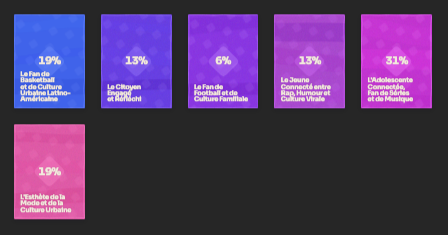
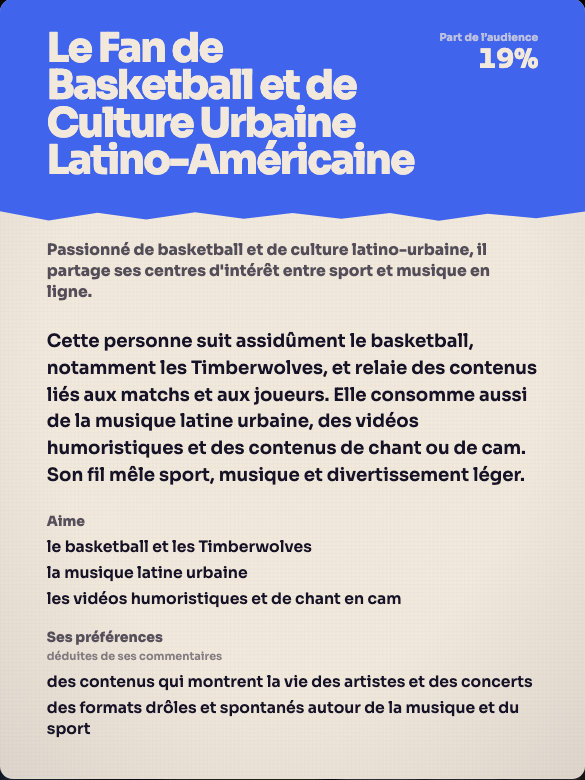
The methods above work without Creatype. The tool helps with the question that comes before the hook: who are you talking to, and in which words? You create a free account (with Google or a link sent by email, no credit card), then paste the link to a TikTok video or account. Creatype reads the video’s context, the public comments and the profiles that react, and returns them as audience profiles.
You see the situations and the vocabulary of the people who react to a video that looks like yours, which gives you what you need to write a first hook that names their wish or their problem in their own words, instead of guessing. The Prisme assistant can then help you write ideas and scripts.
Before launching the analysis, you set the number of profiles, the depth (Light, Standard or In-depth) and the model. A quote is shown before launch, and you can cancel. The Free plan includes the Haiku model, up to 5 audience profiles and 100 accounts examined; the In-depth level is not included. The Go plan (€13 a month, or €120 a year) gives access to all models, the In-depth level, PDF/CSV export and Planifier for 1 followed account. The Pro plan (€105 a month) lets you schedule 5 accounts.
For your first hook: create the free account, paste the link to a video that speaks to your world, and look at who reacts to it. You will write your first sentence for specific people.
See it on a real video: create a free account and analyse a TikTok link.
Analyse for freeSources and further reading
The formulas and examples in this guide are working methods. The passages that mention TikTok come from the two official pages below: tips from creators published by TikTok, and its analytics tutorial.
Try it on your own video
The free plan needs no card: create your account, paste a TikTok link, get the audience profiles. Go (€13/month) adds every model, Deep analysis, PDF and CSV export and Schedule.
Was this article helpful?